UDC 551.583:632.125
Pugacheva A.M., Belyaev A.I., Trubakova K.Yu., Romadina O.D. Regional Climate Changes in Dry Steppes and their Connection to Droughts // Arid Ecosystems. 2022. Vol. 28. № 4 (93). P. 13-21. | PDF
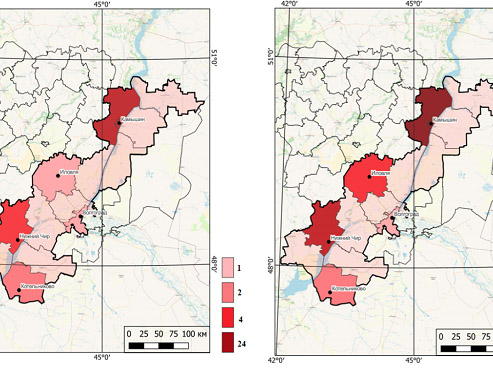
The authors carried out an analysis of the regional climate for separate administrative districts of the Volgograd region for the first time. Differences were revealed based on temperature data and incoming precipitation. The study of the Volgograd region in the context of natural and climatic zones and subzones is of particular interest. This makes it possible to analyze multidirectional trends of climate change in a limited area. The open data of the climatic archive (VNIIGMI-MCD) on 5 reference weather stations of the region located in the dry steppes of chestnut soils were used in the work. The droughts were calculated on the basis of temperature and precipitation anomalies using Pedj Drought Index. Regional changes in the climate were identified in terms of the flow of precipitation during the seasons of active vegetation (spring, summer) according to long-term time series of data from registered meteorological stations. Regression analysis showed an increase in their reception in the spring and a decrease in the summer. Also, an increase in the number of droughts in the summer period was revealed with a decrease in aridity. This effect increases the intensity using Pedj Drought Index, the value of which reaches 3 units. A slight inverse correlation was found between the amount of incoming precipitation and the number of droughts in the summer in Volgograd, Surovikinsky, Ilovlinsky and Kamyshinsky districts and dry phenomena in the Surovikinsky district, as well as a direct moderate dependence on droughts in the Kamyshinsky district in summer. Areas with the maximum number of drought events have been identified, therefore, having the maximum risks of agricultural production. In Kamyshinsky district there were 21 drought events in spring, 115 in summer and in Surovikinsky district there were 4 drought events in spring, 70 in summer. In accordance with the results obtained, especially in the regions most susceptible to the influence of droughts, it is necessary to adjust the existing crop rotation schemes, the range of cultivated crops and a shift in emphasis towards conducting reclamation agriculture in these territories in order to eliminate the risks of agricultural production with the effective use of land resources. Regional climate studies are necessary for conducting effective agricultural activities. This makes it possible to objectively assess the situation with climate change at the level of administrative districts. The information obtained is necessary for the purpose of making managerial, risk-free decisions for agricultural production for agricultural regions.
Keywords: climate change, seasons of active vegetation, moisture availability during the seasons of active vegetation, droughts, aridity, dry steppe, chestnut soils.
Acknowledgements. The authors are grateful to the research engineer of the Laboratory of Geoinformation Modeling and Mapping of Agroforestry Landscapes of the Federal Research Center of Agroecology of the Russian Academy of Sciences A.A. Vasilchenko for the cartographic material prepared for the article.
Funding.The work was carried out within the framework of the State Task of the Federal Research Center of Agroecology of the Russian Academy of Sciences «Theoretical foundations of the functioning and natural-anthropogenic transformation of agroforestry complexes in transitional natural-geographical zones, patterns and forecast of their degradation and desertification based on geoinformation technologies, aerospace methods and mathematical cartographic modeling in modern conditions».:
DOI: 10.24412/1993-3916-2022-4-13-21
EDN: ZNQHLZ