
↓
 

ISSN 1993-3916

Arid Ecosystems

The “Arid Ecosystems” journal was organized by the decision of General Biology Division of the Russian Academy of Sciences.

  •  Home
  • Preprint
  • Contacts
  • Open Access 
  • Archive
    • Issues 1990s
      • Issues for 1995
      • Issues for 1996
      • Issues for 1997
      • Issues for 1998
      • Issues for 1999
      • Issues for 2000
    • Issues 2000s
      • Issues for 2001
      • Issues for 2002
      • Issues for 2003
      • Issues for 2004
      • Issues for 2005
      • Issues for 2006
      • Issues for 2007
      • Issues for 2008
      • Issues for 2009
      • Issues for 2010
    • Issues 2010s
      • Issues for 2011
      • Issues for 2012
      • Issues for 2013
      • Issues for 2014
      • Issues for 2015
      • Issues for 2016
      • Issues for 2017
      • Issues for 2018
      • Issues for 2019
    • Issues 2020s
      • Issues for 2020
      • Issues for 2021
      • Issues for 2022
      • Issues for 2023
      • Issues for 2024

Архив метки: bioindication

ASSESSMENT OF THE EFFICIENCY OF BIOREMEDIATION BY OIL-CONTAMINATED EUTRIC CAMBISOLS IN THE REPUBLIC OF KALMYKIA (MODEL EXPERIMENT)

Arid Ecosystems

UDC 631.453:632.122.2

Minnikova T.V., Ruseva A.S., Revina S.Yu., Kolesnikov S.I., Gaivoronsky V.G. ASSESSMENT OF THE EFFICIENCY OF BIOREMEDIATION BY OIL-CONTAMINATED EUTRIC CAMBISOLS IN THE REPUBLIC OF KALMYKIA (MODEL EXPERIMENT) // Arid Ecosystems. 2023. Vol. 29. № 4 (97). P. 166-176. | PDF

Eutric Cambisols of the Republic of Kalmykia are subject to high levels of oil pollution. To assess the ecological state of soils, it is necessary to analyze not only the residual oil content, but also the biological indicators of soils. The purpose of this work is to evaluate the effectiveness of bioremediation of the oil-contaminated Eutric Cambisols of the Republic of Kalmykia with the help of physicochemical and biological indicators. Biochar, nitroammophos, sodium humate, and «Baikal EM-1» were added to oil-contaminated soil (5% of the soil mass). To assess the effectiveness of remediation of Eutric Cambisols after 30 days, the residual oil content, the activity of catalase and dehydrogenases, the number of bacteria, the length of roots, and germination of radish were studied. It has been established that the introduction of biochar and «Baikal EM-1» reduces the residual oil content in Eutric Cambisols. Biochar and nitroammophos affect the content of easily soluble salts, and «Baikal EM-1» – on the redox potential. Sodium humate stimulates catalase activity (r = -0.48), length of shoots (r = -0.54), length of roots (r = -0.54), and germination of radish (r = -0.64). Nitroammophos stimulates the number of bacteria (r = -0.56), activity of catalase (r = -0.63) and dehydrogenases (r = -0.84), but inhibits the length of shoots and roots of radish (Raphanus sativus L.). The introduction of «Baikal EM-1» stimulates the number of soil bacteria (r = -0.83), the activity of dehydrogenases (r = -0.89) and inhibits germination and the length of roots, shoots. It is advisable to use the results of the study in biomonitoring and diagnosing the state of oil-contaminated Eutric Cambisols of the Republic of Kalmykia.

Keywords: soil, remediation, ecological state, bioindication.

Funding. The study was supported by a grant from the President (MK-175.2022.5), with the financial support of the project of the Strategic Academic Leadership Program of the Southern Federal University (“Priority 2030”) for the creation of the Youth Laboratory of Ecobiotechnologies for Diagnosis and Protection of Soil Health (No. SP-12-23-01 ), the Ministry of Science and Higher Education of the Russian Federation, the laboratory «Soil Health» of the Southern Federal University (agreement No. 075-15-2022-1122), the project of the Ministry of Education and Science of Russia «Laboratory of Young Scientists» within the framework of the Interregional Scientific and Educational Center of the South of Russia (No. LabNOTS- 21-01AB, FENW-2021-0014).

DOI: 10.24412/1993-3916-2023-4-166-176

EDN: YVASSE

ASSESSING THE IMPACT OF AVIARY HOUSING OF ANIMALS ON THE ECOLOGICAL CONDITION OF SOILS

Arid Ecosystems

UDC 631.4; 574.4

Gobarova A.A., Kazeev K.Sh., Zhadobin A.V.,  Fedorenko A.N., Kolesnikov S.I. ASSESSING THE IMPACT OF AVIARY HOUSING OF ANIMALS ON THE ECOLOGICAL CONDITION OF SOILS // Arid Ecosystems. 2023. Vol. 29. № 2 (95). P. 109-117. | PDF

The activities of animals have a significant impact on the area of their habitat. The objects under our study are located in the dry steppes zone, the climate of which limits the development of vegetation and contributes to changes in soil characteristics, which, combined with the impact of animals, increases its effect. The aim of our work was to assess the impact of animals on the ecological condition of the soils in the enclosures of the “Wildlife Steppe” Association (orig. “Zhivaya Priroda Stepi”).

During our study, the main indicators of the ecological state of soil in the enclosures with animals, located in the arid area of Rostov Region, were determined. We studied enclosures of different sizes, with common ostriches (Struthio camelus), emus (Dromaius novaehollandiae), goats (Capra sp.), Przewalski’s horses (Equus ferus przevalskii) and saiga antelopes (Saiga tatarica), and the grazing areas of horses (Equus caballus), Bactrian camels (Camelus bactrianus), wild water buffalos (Bubalus arnee), wild yaks (Bos mutus) and guanacos (Lama ganicoe). Level of soil degradation differed from area to area. Soil moisture, temperature, density and texture were determined to assess the physical condition, pH, gross soil chemistry, humus content and biological activity; then the plots were ranked according to the degree of pasture degradation.

The enclosure of common ostriches had the maximum degradation of 10 degrees, characterized by severe vegetation depression and soil battering. The soil density in their enclosure was also the highest and reached 1.49 g/cm3, while the structure was the lowest and reached only 37%. These parameters had a strong negative correlation with hoof and foot pressure on the soil (-0.9). Moisture levels never exceeded 11% in the study areas, although soil enzymatic activity was more influenced by animal excreta than by hydrothermal conditions. In the enclosures with ungulates, goats in particular, catalase and urease activity was always higher than in other plots. There was also a high humus content (10.3%), uncharacteristic for chestnut soils and confirmed by the influence of animals’ activity.

According to the results of our study, the lowest values of structure, humus and biological activity, as well as increased density of soil compaction, were in the enclosure with common ostriches. The findings explain the reduced growth and development of vegetation in the area where the animals were kept in crowded conditions.

Keywords: pasture digression, ecological condition, enzymatic activity, bioindication, content of organic matter, physical properties.

Financing. The research was supported financially by the leading scientific school of Russia “Assessment and Forecast of Soil Conditions under Various Anthropogenic Influences and Climate Change” (NSH-449.2022.5).

DOI: 10.24412/1993-3916-2023-2-109-117

EDN: WRCBNN
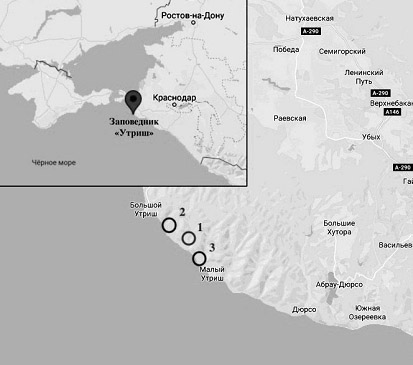
RESPONSE OF ENZYME ACTIVITY OF ARID FOREST SOILS OF THE BLACK SEA COAST OF THE CAUCASUS TO PYROGENIC EFFECTS

Arid Ecosystems

UDC 631.95: 631.6.02

Vilkova V.V., Kazeev K.Sh., Shkhapatsev A.K., Kolesnikov S.I. RESPONSE OF ENZYME ACTIVITY OF ARID FOREST SOILS OF THE BLACK SEA COAST OF THE CAUCASUS TO PYROGENIC EFFECTS // Arid ecosystems. 2022. V.28. № 1 (90). P. 106-113. | PDF

In recent years, the spread of wildfires in Russia and the world has increased. Fires have a catastrophic impact on forest ecosystems, as well as a significant impact on the biota and biological activity of soils. The enzyme activity of arid forest Cambisol of the Black Sea coast of the Caucasus after exposure to fires has been evaluated. The study area is located on the Abraus Peninsula of the Black Sea coast of Russia in the state nature reserve «Utrish». The xerophytic forests and woodlands common here consist of various types of junipers, oaks, pistachios and other species, the soil cover is represented by a Cambisol combination of varying degrees of thickness, stony, carbonate and humus. The studied post-pyrogenic sites differ by a different recovery period (0-11 years). Soil samples were taken from three different depths (0-3, 3-10 and 20-30 cm) in three-fold repetition. A significant long-term effect of fires on the activity of enzymes (catalase, invertase, peroxidase, urease) in subtropical Cambisol has been shown. The content of organic carbon in the surface horizon immediately after a fire increases due to the accumulation of pyrogenic carbon of ash and soot on the soil surface. A year after the fire, the carbon content in the soils decreases by 47%, and after 11 years it approaches the control values. The activity of catalase, urease and phosphatase of post-pyrogenic Cambisol immediately after the fire was reduced by 43-69% compared to the soil of the control site. The activity of peroxidase, on the contrary, was stimulated by fire. In the future, the degree of inactivation of enzymes and changes in the organic carbon content in post-pyrogenic soils depended on the time of post-pyrogenic restoration of ecosystems and the type of enzyme. The peculiarities of changes in the activity of enzymes during the restoration of post-pyrogenic Cambisol were revealed. The complete restoration of the enzymatic activity of post-pyrogenic Cambisol did not occur even 11 years after the fire. A change in the correlations of enzyme activity and the content of organic carbon in the soil in post-pyrogenic Cambisol of different ages has been established.

Keywords: soil enzymes, pyrogenic effect, wildfires, bioindication.

Acknowledgements. The authors express their gratitude to O.N. Bykhalova, the deputy director for scientific work of the “Utrish” State Nature Reserve, for allowing us to carry out the research on the territory of the reserve.

Financing. The study was carried out with the state support of the leading scientific school of the Russian Federation “Agroecological state of soils under various anthropogenic influences” (NSH-2511.2020.11).

DOI: 10.24412/1993-3916-2022-1-107-114

About the Journal

  • General Information
  • Open Access 
  • Preprint
  • Topics of the journal
  • Editoral Board
  • Editorial Policy
  • Editorial Ethics

Articles Supplying

  • Rules of Manuscripts Supplying
  • Articles Design
  • Article Structure
  • Guidens for Writing an Article
  • Articles Translation

Review of manuscripts

  • Review of manuscripts

Archive

  • 1990s editions
  • 2000s editions
  • 2010s editions
  • 2020s editions
    • Issues for 2020
    • Issues for 2021
    • Issues for 2022
    • Issues for 2023
    • Issues for 2024
  • Events

_______________________

©2025 - Arid Ecosystems - Weaver Xtreme Theme
↑