↓
 

ISSN 1993-3916

Arid Ecosystems

The “Arid Ecosystems” journal was organized by the decision of General Biology Division of the Russian Academy of Sciences.

  •  Home
  • Preprint
  • Contacts
  • Open Access 
  • Archive
    • Issues 1990s
      • Issues for 1995
      • Issues for 1996
      • Issues for 1997
      • Issues for 1998
      • Issues for 1999
      • Issues for 2000
    • Issues 2000s
      • Issues for 2001
      • Issues for 2002
      • Issues for 2003
      • Issues for 2004
      • Issues for 2005
      • Issues for 2006
      • Issues for 2007
      • Issues for 2008
      • Issues for 2009
      • Issues for 2010
    • Issues 2010s
      • Issues for 2011
      • Issues for 2012
      • Issues for 2013
      • Issues for 2014
      • Issues for 2015
      • Issues for 2016
      • Issues for 2017
      • Issues for 2018
      • Issues for 2019
    • Issues 2020s
      • Issues for 2020
      • Issues for 2021
      • Issues for 2022
      • Issues for 2023
      • Issues for 2024

Архив метки: ontogenetic structure

ONTOGENETIC STRUCTURE OF POPULATIONS OF RINDERA TETRASPIS PALL. (BORAGINACEAE) IN ORENBURG REGION

Arid Ecosystems

UDC 58.009:582.948.25

Mustafina A.N., Abramova L.M., Karimova O.A. ONTOGENETIC STRUCTURE OF POPULATIONS OF RINDERA TETRASPIS PALL. (BORAGINACEAE) IN ORENBURG REGION // Arid Ecosystems. 2023. Vol. 29. № 4 (97). P. 48-55. | PDF

Assessment of the current state of populations of rare plant species using population-ontogenetic methods is used in solving problems of conservation and restoration of natural communities. The object of the study was a rare species of the European part of Russia – Rindera tetraspis Pall. is a little-studied steppe endemic species, declining in numbers. The aim of the study was to study the features of the ontogenetic structure and the current state of coenopopulations (CP) of R. tetraspis in the Cis-Urals of the Orenburg region. In 2016-19 a survey of three administrative districts of the Cis-Urals of the Orenburg region was carried out, as a result, 6 CPs were identified and studied. An assessment of the phytocenotic confinement of the CP was carried out using traditional geobotanical methods. The leading population characteristics are determined: the density of individuals, the ontogenetic composition. As a result of the conducted research, it was revealed that the predominant type of vegetation is desert viticultural, wormwood-brittle-grass-grass calcephytic and curly bluegrass-tyrs steppe communities. The total density in the examined CPs varies from 4.7 to 10.7 ind./m2, the effective density is 3.2-5.9 ind./m2. Ontogeny is described, 8 ontogenetic states are revealed, senile individuals are not found. All the studied CPs of R. tetraspis are normal incomplete, the peak falls on middle-aged generative individuals. According to the delta-omega classification, 3 CPs are young, 2 are transitional, and one is mature. The state of the studied populations is relatively satisfactory. But out of the six studied CPs, only one CP is protected, it is located in the «Troitsky Chalk Mountains». To strengthen the protection of the species, constant monitoring of the state of populations is necessary.

Keywords: rare species, Rindera tetraspis Pall., Boraginaceae, Orenburg region, cоenopopulation, density, ontogenetic structure.

Funding. The work was carried out on the topic of the UUBSI of the UFIC RAS «Biodiversity of natural systems and plant resources of Russia: assessment of the state and monitoring of dynamics, problems of conservation, reproduction, increase and rational use» within the framework of the state task for 2022 of the UFIC RAS No. 075-03-2022-001 dated 14.01.2022.

DOI: OWOUIU

EDN: 10.24412/1993-3916-2023-4-48-55

ASSESSMENT OF THE STATUS OF THE COENOPOPULATION OF ALLIUM PRAEMIXTUM IN VVED. IN THE RANGES OF UZBEKISTAN

Arid Ecosystems

UDC 581.93 (470.67); 581.522.5

Saribaeva Sh.U., Allamuratov A., Mavlyanov B., Mamatkosimov O.  ASSESSMENT OF THE STATUS OF THE COENOPOPULATION OF ALLIUM PRAEMIXTUM IN VVED. IN THE RANGES OF UZBEKISTAN // Arid Ecosystems. 2023. Vol. 29. № 4 (97). P. 56-62. | PDF

The article presents the results of studying the state of the cenopopulation of a rare species – Allium praemixtum in the Nurata and Turkestan ranges. The ontogenetic structure of the coenopopulation was studied by the generally accepted method (Uranov, 1975; Coenopopulations…, 1976). Coenopopulations were characterized according to the classifications of A.A. Uranov and O.V. Smirnova (1969) and «delta-omega» (Zhivotovsky, 2001). The ecological density was determined according to W. Odum (1986). Geobotanical descriptions were made according to the standard method on plots of 100 m2 (Field geobotany, 1964). The characteristic ontogenetic spectrum is left-sided and with an absolute maximum in one of the pregenerative groups (Cheremushkina, 2004). Coenopopulations 1, 5, 6 correspond to the typical left-sided ontogenetic spectrum with a maximum peak in the virginal state of the species. The centered onogenetic spectrum does not coincide with the characteristic spectrum, culminating in the middle-aged state. The bimodal onogenetic spectrum should be considered as a temporary variant of the left-sided one with an equal peak in the medium generative and virginal states. The density of individuals in the studied coenopopulations varied from 1.1 to 9.7 ind./m2, and the ecological density was 2.3-17.63 ind./m2. According to the “delta-omega” classification, coenopopulations of Allium praemixtum CP 1 are maturing, CP 5 and 6 are young, CP 2.4 are transitional, CP are mature. The existing coenopopulations are mainly located outside the territory of the Nurata Reserve, except for coenopopulation 3 (near Mazhrumsay) and CP 4 (near Gurdarasay). The only solution to this problem can be the strict protection of coenopopulations.

Keywords: biodiversity, Allium praemixtum, phytocenosis, ontogenetic structure, coenopopulation, plant protection.

Funding. The work was carried out within the framework of the project of the state scientific and technical program of the Republic of Uzbekistan «Assessment of the current state of populations and creation of a living collection of economically valuable species of wild relatives of cultivated plants of the flora of Uzbekistan».

DOI: 10.24412/1993-3916-2023-4-56-62

EDN: MRCMAM

CURRENT STATE OF CENOPOPULATIONS OF SOME ENDEMIC AND RARE SPECIES OF GENUS TULIPA L. (LILIACEAE) IN TASHKENT REGION (UZBEKISTAN)

Arid Ecosystems

UDC 581.4:55

Beshko N.Yu., Abduraimov O.S., Kadyrov U.Kh., Madaminov F.M., Makhmudov A.V. CURRENT STATE OF CENOPOPULATIONS OF SOME ENDEMIC AND RARE SPECIES OF GENUS TULIPA L. (LILIACEAE) IN TASHKENT REGION (UZBEKISTAN) // Arid Ecosystems. 2023. Vol. 29. № 3 (96). P. 68-80. | PDF

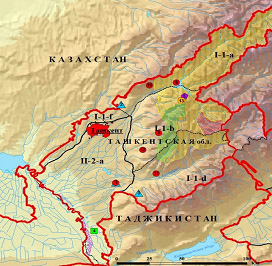
The study of the ontogenetic structure of the coenotic populations of vulnerable, endemic and rare plant species allows us to assess their state under the conditions of anthropogenic transformation of ecosystems and develop the scientific basis for their protection. Central Asia is considered as one of the centers of origin and diversity of the genus Tulipa L. 34 species of tulips are recorded for the flora of the Republic of Uzbekistan, 19 species of them (55.88%) are threatened due to the collection of flowers and bulbs, overgrazing and habitat loss, and listed in the national Red Data Book. The paper is devoted to the assessment of the current state of 13 coenotic populations of 5 rare and endemic species of the genus Tulipa L. (T. borszczowii, T. butkovii, T. dubia, T. greigii, T. korolkowii) growing in the Tashkent region of Uzbekistan in areas with different environmental regimes and levels of anthropogenic pressure. It has been found that 8 studied coenopopulations are normal and complete; 5 populations are incomplete, without senile individuals, this is a biological feature of the genus Tulipa. 6 coenopopulations are of the left-sided type, their ontogenetic spectrum fits with the characteristic spectrum of the genus Tulipa; 4 coenopopulations have a centered type of spectrum and 3 are bimodal. The low ratio of young individuals in some coenopopulations can be explained by the impact of overgrazing, as well as high competition with other species in the community. It is recommended to include Tulipa borszczowii, a rare endemic of the Central Asian deserts, and Tulipa butkovii, national endemic and local endemic to the Chatkal Ridge, in the next edition of the Red Data Book of Uzbekistan. It is recommended to create a protected area (wildlife sanctuary or natural monument) for conservation of the relic sandy massif of Dalverzin Sands in the Tashkent region.

Keywords: anthropogenic press, Red Data Book, ontogenetic structure, rare species, Uzbekistan, coenotic population, endemic, Liliaceae, Tulipa L.

Financing. The work was carried out as part of the state research programs of the Institute of Botany of the Academy of Sciences of the Republic of Uzbekistan “Cadaster of Flora of the Tashkent Region” (2020-2022) and “Assessment of the Current State of Populations and Creation of a Living Collection of Economically Valuable Species of Wild Relatives of Cultivated Plants of the Flora of Uzbekistan” (2021-2024).

DOI: 10.24412/1993-3916-2023-3-68-80

EDN: PHWIBU

STATE OF XYLOSALSOLA CHIWENSIS (POPOV) AKHANI & ROALSON AND SCORZONERA BUNGEI KRASCH. & LIPSCH. CENOPOPULATIONS ON THE USTYURT PLATEAU, UZBEKISTAN

Arid Ecosystems

UDC 581.5 (575.13)

Rakhimovа N.K., Rakhimova T., Shomurodov Kh.F., Sharipova V.K. STATE OF XYLOSALSOLA CHIWENSIS (POPOV) AKHANI & ROALSON AND SCORZONERA BUNGEI KRASCH. & LIPSCH. CENOPOPULATIONS ON THE USTYURT PLATEAU, UZBEKISTAN // Arid Ecosystems. 2023. Vol. 29. № 2 (95). P. 77-84. | PDF

It is our priority to conduct environmental monitoring, protect rare plant species and conduct studies to assess the state of populations of rare and endangered plants using coenopopulation approaches is a priority, along with the conservation of plant communities with participation of rare species. The aim of our work was to study the ecological and phytocenotic state of rare Xylosalsola chiwensis and Scorzonera bungei coenotic populations in Ustyurt. These species are listed in the Red Data Book of the Republic of Uzbekistan. We provide the characteristics of plant communities with cenopopulations of the studied species. The ontogenetic structure of these species has been studied. The results showed that in the ecological and cenotic conditions of Ustyurt, the studied coenopopulations are normal, but incomplete. The basic ontogenetic spectrum is centered, with a peak of the middle-aged generative plants. The spectra of specific cenopopulations are centered and left-sided due to the ecological habitat conditions and weather fluctuations. With the development of distant pastures and the planning of linear infrastructures, these species must be protected. The results of this study will be used in the next editions of the Red Data Book of the Republic of Uzbekistan.

Keywords: Xylosalsola chiwensis, Scorzonera bungei, Aral Sea, Ustyurt plateau, biodiversity, ontogenetic structure, cenopopulation.

Funding. The work was carried out for the project F5-FA-0-13289 “Modern Trends in the Development of Vegetation and Wildlife of Ustyurt in the Process of Desertification” and the state program (PFI-5) “Assessment of the Current State of Vegetation Cover and Pasture Resources of the Republic of Karakalpakstan”.

DOI: 10.24412/1993-3916-2023-2-77-84

EDN: ZUUMIF

ONTOGENESIS AND ONTOGENETIC STRUCTURE OF COENOPOPULATIONS OF THE ASTRAGALUS HOLARGYREUS BUNGE (FABACEAE), NARROW-LOCALITY ENDEMIC OF KYZYLKUM

Arid Ecosystems

UDC 581.5+581.14 (575.13)

Saribaeva Sh.U., Shomurodov H.F., Abduraimov O.S. ONTOGENESIS AND ONTOGENETIC STRUCTURE OF COENOPOPULATIONS OF THE ASTRAGALUS HOLARGYREUS BUNGE (FABACEAE), NARROW-LOCALITY ENDEMIC OF KYZYLKUM // Arid ecosystems. 2022. V.28. № 1 (90). P. 91-97. | PDF

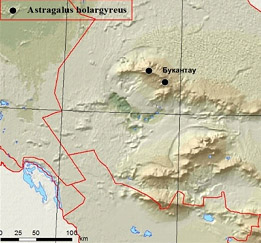
Analysis of the current state of the narrow-local endemic of the Kyzylkum Astragalus holargyreus showed that the studied coenopopulations are normal and incomplete. The study showed coenopopulations of A. holargyreus are normal and incomplete. The age spectrum of the first coenopopulation responds to the characteristic spectrum and reflects the biological features of the species: a gradual increase in life expectancy in the juvenile fraction and generative periods with a culmination in the middle-aged state, rapid aging. The ontogenetic spectrum in the second coenopopulation does not coincide with the characteristic spectrum. According to the amount of the points of organism and population signs, all the examined coenopopulations are in a stable state.

Keywords: ontogenesis, Kyzylkum desert, Astragalus holargyreus, Bukantau range, ontogenetic structure, coenopopulation.

Financing. The work was carried out with the support of the project of the Ministry of Innovation of the Republic of Uzbekistan, scientific project No. P3-2014-0828163420 “Assessment of the state of coenopopulations of rare and endangered plant species of the remnant lowlands of Kyzylkum in connection with desertification”.

DOI: 10.24412/1993-3916-2022-1-91-98

CURRENT STATE CRAMBE EDENTULA FISCH. & C.A. MEY. EX KORSH. ON THE PLATO OF USTURT IN UZBEKISTAN

Arid Ecosystems

Rakhimova N.K., Rakhimova T., Adilov B.A., Tamambetova Sh.B., Polvonov F.I. CURRENT STATE CRAMBE EDENTULA FISCH. & C.A. MEY. EX KORSH. ON THE PLATO OF USTURT IN UZBEKISTAN // Arid ecosystems. 2021. V.27. № 4 (88). P. 70-76. | PDF

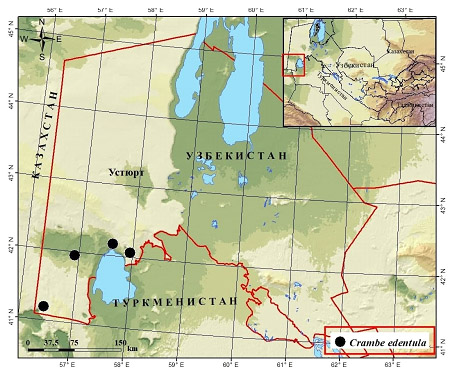
The article is devoted to the assessment of the state of the ontogenetic structure of the rare species Crambe edentula Fisch. & C.A. Mey. ex Korsh., growing in the Karakalpak part of Ustyurt. The study showed that in the ecological-cenotic conditions of Ustyurt, the studied cenopopulations are normal, mostly incomplete. The characteristic ontogenetic spectrum for C. edentula is centered due to an increase in the life span of individuals in a mature generative state and poor seed renewal. Ontogenetic spectra of cenopopulations do not coincide with the characteristic one. The spectra of specific cenopopulations are left-sided and right-sided, which is associated with ecological habitat conditions and fluctuations in weather conditions.

Keywords: Ustyurt plateau, infrastructure development, endemics, rare plant species, ontogenetic structure, age and efficiency of cenopopulations.

DOI: 10.24412/1993-3916-2021-4-70-76

ONTOGENETIC STRUCTURE OF RARE SPECIES ON THE USTYURT PLATEAU IN UZBEKISTAN

Arid Ecosystems

Rakhimova Т., Rakhimova N.К.,  Shomurodov Kh.F.,  Abduraimov О.S. Ontogenetic Structure of Rare Species on the Ustyurt Plateau in Uzbekistan // Arid ecosystems. 2020. V. 26. № 3 (84). P. 71-78. | PDF

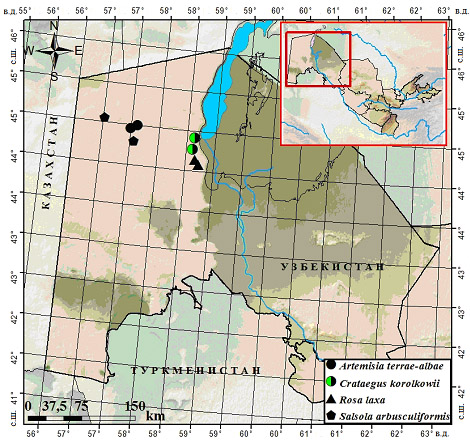
The research assesses the state of the ontogenetic structure of some rare species (Rosa laxa Retz., Crataegus korolkowii L. Henry, Artemisia terrae-albae Krasch. and Salsola arbusculiformis Drob.) growing on the Karakalpak part of Ustyurt. The study shows that the studied cenopopulations are normal and mostly incomplete under the ecological and cenotic conditions of Ustyurt. The ontogenetic spectra of specific cenopopulations are left-sided and centered, which associated with the environmental living conditions and fluctuations in weather conditions. The similarity of biological features (long-term life expectancy of individuals in a middle-age ontogenetic state, the least elimination, and difficult seed germination) in individuals of different species and the actual, ontogenetic spectra with a characteristic spectrum indicates a stable state of the studied cenopopulations on the Karakalpak part of Ustyurt.

Key words: Ustyurt plateau, infrastructure development, endemics, rare plant species, ontogenetic structure, age and efficiency of cenopopulations.

DOI: 10.24411/1993-3916-2020-10109

About the Journal

  • General Information
  • Open Access 
  • Preprint
  • Topics of the journal
  • Editoral Board
  • Editorial Policy
  • Editorial Ethics

Articles Supplying

  • Rules of Manuscripts Supplying
  • Articles Design
  • Article Structure
  • Guidens for Writing an Article
  • Articles Translation

Review of manuscripts

  • Review of manuscripts

Archive

  • 1990s editions
  • 2000s editions
  • 2010s editions
  • 2020s editions
    • Issues for 2020
    • Issues for 2021
    • Issues for 2022
    • Issues for 2023
    • Issues for 2024
  • Events

_______________________

©2025 - Arid Ecosystems - Weaver Xtreme Theme
↑