
↓
 

ISSN 1993-3916

Arid Ecosystems

The “Arid Ecosystems” journal was organized by the decision of General Biology Division of the Russian Academy of Sciences.

  •  Home
  • Preprint
  • Contacts
  • Open Access 
  • Archive
    • Issues 1990s
      • Issues for 1995
      • Issues for 1996
      • Issues for 1997
      • Issues for 1998
      • Issues for 1999
      • Issues for 2000
    • Issues 2000s
      • Issues for 2001
      • Issues for 2002
      • Issues for 2003
      • Issues for 2004
      • Issues for 2005
      • Issues for 2006
      • Issues for 2007
      • Issues for 2008
      • Issues for 2009
      • Issues for 2010
    • Issues 2010s
      • Issues for 2011
      • Issues for 2012
      • Issues for 2013
      • Issues for 2014
      • Issues for 2015
      • Issues for 2016
      • Issues for 2017
      • Issues for 2018
      • Issues for 2019
    • Issues 2020s
      • Issues for 2020
      • Issues for 2021
      • Issues for 2022
      • Issues for 2023
      • Issues for 2024

Архив метки: seasonal dynamics

LONG-TERM DYNAMICS OF STOCKS OF LIVING ABOVE-GROUND PHYTOMASS OF STEPPE PHYTOCENOSES AFTER A WILD FIRE (ON THE EXAMPLE OF THE BURTINSKAYA STEPPE OF THE ORENBURG NATURE RESERVE)

Arid Ecosystems

UDC 581.5;58.02

Dusaeva G.Kh., Kalmykova O.G. LONG-TERM DYNAMICS OF STOCKS OF LIVING ABOVE-GROUND PHYTOMASS OF STEPPE PHYTOCENOSES AFTER A WILD FIRE (ON THE EXAMPLE OF THE BURTINSKAYA STEPPE OF THE ORENBURG NATURE RESERVE) // Arid Ecosystems. 2023. Vol. 29. № 2 (95). P. 67-76. | PDF

In recent years the area and frequency of wild fires was growing catastrophically in the steppes of the arid regions of the Russian Federation. The fires destroy the above-ground part of phytocenoses, significantly reducing the stocks of above-ground phytomass and productivity of communities, and changing the structure and composition of steppe phytocenoses. The purpose of our work was to study the effect of the pyrogenic factor on the stocks of living above-ground phytomass, and determine the time required for its full recovery. After a wild fire in 2015, 6 monitoring sites were established in the Burtinskaya Steppe of the Orenburg Nature Reserve. Each site included a control (intact) plot and a burned plot. Standard geobotanical methods were used along with mowing to identify the features and dynamics of the stocks of living above-ground phytomass. The studies were carried out in 2015-2020. As a result, we found out that the reserves of phytomass (g/m2) can reach the value of the control communities in the 2nd year of the study. The seasonal dynamics of live phytomass starting from the 3rd to 4th year after burning are mostly affected by the community composition and type instead of the pyrogenic factor. During the entire period of our study, the proportion of live phytomass stocks of burned communities reached the values of control phytocenoses. However, it was always higher than the control values, which indicates incomplete restoration of the structure of the above-ground phytomass of the burnt area.

Keywords: steppe fires, stocks of living above-ground phytomass, seasonal dynamics, year-to-year dynamics, protected areas, revegetation, Orenburg region.

Financing. The work was carried out for the state task of the Steppe Institute of the Ural Branch of the Russian Academy of Sciences “Problems of Steppe Nature Management in the Conditions of Modern Challenges: Optimization of the Interaction of Natural and Socio-economic Systems” (Project No. GR AAAA-A21-121011190016-1).

DOI: 10.24412/1993-3916-2023-2-67-76

EDN: HKXEXJ
STABILITY OF PHYTOMASS DYNAMICS IN PROTECTED LOW MOUNTAIN-STEPPE LANDSCAPES AND PASTURES IN THE SOUTHERN URALS

Arid Ecosystems

UDC 911.2 (470.56)

Khoroshev A.V. STABILITY OF PHYTOMASS DYNAMICS IN PROTECTED LOW MOUNTAIN-STEPPE LANDSCAPES AND PASTURES IN THE SOUTHERN URALS // Arid ecosystems. 2022. V.28. № 3 (92). P. 3-13. | PDF

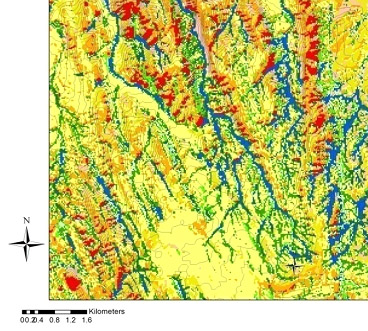
In the steppe zone, the high sensitivity of the vegetation cover to humidification contrasts raises the question of the dependence of the intraseasonal dynamics of phytomass on the spatial pattern of vegetation cover and relief in a landscape. We performed a case study in the Aituarskaya steppe (Orenburg region) to test the hypothesis about the inequality of the spatial factors of variability of functioning under the conditions of the reserve regime and pasture impact. Based on the frequency of occurrence of five gradations of deviations of the intraseasonal increments of the vegetation index NDVI from the mean values, the measure of instability of the types of dynamics of green phytomass (Shannon’s index) was calculated. The relationship between the types of dynamics and the types of natural boundaries, due to belonging to the relief forms with the characteristic types of phytocenoses, has been established. Areas of the most unstable phytoproductive functioning are characteristic of valleys with meadow steppes. The reserve regime stabilizes the dynamics of phytomass due to a higher subordination to landscape-scale climatic processes. On grazed areas, frequent changes in the variants of phytomass increments are more characteristic and dependence on local factors (e.g., stoniness, groundwater level) increases. In the pasture area, in some places, the dominant dynamics becomes with an intensive late spring accumulation of phytomass and a small decrease or renewal by the end of summer due to an increase in the proportion of non-palatable and grazing-resistant species.

Keywords: steppe, landscape, reserve, pasture, phytomass, NDVI, seasonal dynamics, stability, relief, Urals.

Acknowledgements. Expressing gratitude to D.E. Sharova, O.M. Podgorny, I.V. Volovinsky, G.M. Leonova for participation in field research and arrangement of remote materials and to reviewers for constructive comments.

Financing. The study was carried out with the financial support of the Russian Foundation for Basic Research, project No. 20-05-00464 «Spatial structure as a factor of stability of landscape functioning», 2020-2022.

DOI: 10.24412/1993-3916-2022-3-3-13

About the Journal

  • General Information
  • Open Access 
  • Preprint
  • Topics of the journal
  • Editoral Board
  • Editorial Policy
  • Editorial Ethics

Articles Supplying

  • Rules of Manuscripts Supplying
  • Articles Design
  • Article Structure
  • Guidens for Writing an Article
  • Articles Translation

Review of manuscripts

  • Review of manuscripts

Archive

  • 1990s editions
  • 2000s editions
  • 2010s editions
  • 2020s editions
    • Issues for 2020
    • Issues for 2021
    • Issues for 2022
    • Issues for 2023
    • Issues for 2024
  • Events

_______________________

©2025 - Arid Ecosystems - Weaver Xtreme Theme
↑