↓
 

ISSN 1993-3916

Arid Ecosystems

The “Arid Ecosystems” journal was organized by the decision of General Biology Division of the Russian Academy of Sciences.

  •  Home
  • Preprint
  • Contacts
  • Open Access 
  • Archive
    • Issues 1990s
      • Issues for 1995
      • Issues for 1996
      • Issues for 1997
      • Issues for 1998
      • Issues for 1999
      • Issues for 2000
    • Issues 2000s
      • Issues for 2001
      • Issues for 2002
      • Issues for 2003
      • Issues for 2004
      • Issues for 2005
      • Issues for 2006
      • Issues for 2007
      • Issues for 2008
      • Issues for 2009
      • Issues for 2010
    • Issues 2010s
      • Issues for 2011
      • Issues for 2012
      • Issues for 2013
      • Issues for 2014
      • Issues for 2015
      • Issues for 2016
      • Issues for 2017
      • Issues for 2018
      • Issues for 2019
    • Issues 2020s
      • Issues for 2020
      • Issues for 2021
      • Issues for 2022
      • Issues for 2023
      • Issues for 2024
      • Issues for 2025

Архив метки: evaporation

GLOBAL SIGNIFICANCE OF TEMPORAL-FUNCTIONING PROPERTIES OF ARID SOILS AT VARIOUS DESERTIFICATION STAGES

Arid Ecosystems

Zalibekov Z.G., Musayev M.A., Asgerova D.B. GLOBAL SIGNIFICANCE OF TEMPORAL-FUNCTIONING PROPERTIES OF ARID SOILS AT VARIOUS DESERTIFICATION STAGES // Arid Ecosystems. 2025. Vol. 31. № 2 (103). P. 33-44. | PDF

Numerous researches of the processes of desertification and aridization in arid lands and continental deserts have established the basis for differentiating seasonal (temporal) changes that facilitate the replacement of arid soil characteristics and corresponding ecosystem components with elements of a humid regime. Sharp seasonal changes in soil and vegetation moisture are associated with differences in the atmospheric moisture availability during different periods of the year.

The natural stage of processes that help eliminate soil moisture deficits during the autumn-winter and winter-spring in the arid zone of semi-desert and steppe complexes intensifies the drying of soil profiles, enriching the roots layer with moisture in a way that is common for humid regions. The period of plants utilizing the accumulated moisture is 60-70 days, during which the ratio of air temperature and soil moisture is determined within the range optimal for plant growth and development. Identification of a period with an optimal heat/moisture ratio and of certain duration under desertification, including the highest stage of desertification, provides a reason for the development of a technology that differs from the generally accepted zonal technology and takes into account the conditions characteristic of a semi-desert climatic regime (Akimtsev, 1957; Biarslanov et al., 2021).

Funding. This work was carried for the state assignment of the Institute of Geology of the Russian Academy of Sciences “Landscape-geochemical Zoning of the Caspian Lowland”, Section 1, No. AAA-A117-117021310199-9 “Development of Methodological Foundations for Studying the Humus State and Salinization of Soils for Landscape-Geochemical Zoning of Arid Territories”.

Keywords: precipitation, desertification, continental desertification, local desertification, limiting factor, deserts, temporal-functioning properties, humidification stage, evaporation, heat-moisture ratio, properties that reduce soil degradation, highest degree.

DOI: 10.24412/1993-3916-2025-2-33-44

EDN: FWTOBL
MODERN CLIMATE TRENDS OF CHANGES IN EVAPORATION AND SOIL MOISTURE IN THE SOUTH OF EUROPEAN RUSSIA 

Arid Ecosystems

UDC 551.573:551.579.5(470)

Titkova T.B., Zolotokrylin A.N., Cherenkova E.A. MODERN CLIMATE TRENDS OF CHANGES IN EVAPORATION AND SOIL MOISTURE IN THE SOUTH OF EUROPEAN RUSSIA // Arid Ecosystems. 2023. Vol. 29. № 3 (96). P. 4-14. | PDF

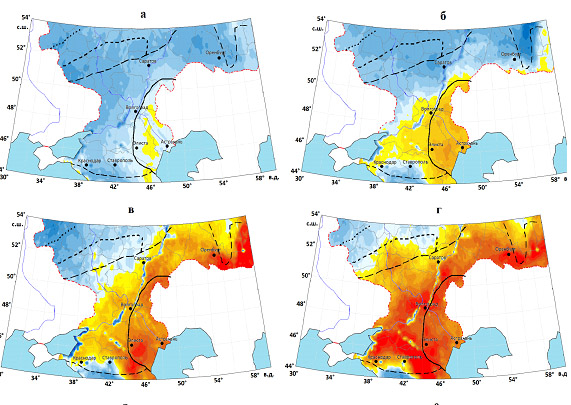
We studied an impact that climate parameters had on evaporation during the active growing season of plant in forest steppe, steppe and semiarid areas in 1980-2021, in the south of European Russia. We analyzed the main patterns of the connection between evaporation and soil moisture. At the beginning of the growing season, a change in evaporation in forest and steppe was largely determined by the positive connection with temperature and wind. In the middle of the season, the role of precipitation and wind increased even more. Starting in July, the connection between evaporation and air temperature turned negative due to the water shortages in dry subhumid and semiarid climates. At the beginning, the connection between evaporation and surface moisture was negative, and the surface evaporation was minimal since the soil cover was not yet warm enough in steppe and forest steppe zones. However, this connection was positive in warm soil in the semidesert. Starting from the middle of the season and until its end, the connection between evaporation and soil moisture was significantly positive everywhere from forest steppe to semiarid zones. At the beginning, the continuous warming increased the evaporation. In the middle and the end, evaporation trends were significantly negative because the insufficient moisture at higher temperatures resulted in drying of the soil cover and early vegetation decay. The largest evaporation decline was noted in steppe and dry steppe landscapes, caused by the overall drying of the territory when the air temperatures grew, as well as by the decrease both of precipitation and the average wind speed. Surface moisture trends were mostly negative in the south of European Russia, with the maximum moisture loss in broadleaf forests and forest steppe because they were more humid compared to dry steppe and semiarid zones. Changes in soil moisture in the semiarid zone throughout the entire warm period were minimal.

Keywords: evaporation, air temperature, precipitation, wind, soil moisture, natural zones, growing season.

Financing. The study of the influence of climatic parameters on evaporation was carried out within the framework of scientific topic No. 0127-2019-0010 (AAAA19-119102890091-1) “Development of Scientific Foundations for Sustainable Management of Natural and Anthropogenic Systems Based on Balanced Land Use Models”; the analysis of trends in abnormal regimes of soil moisture was financially supported by the Russian Science Foundation, project No. 19-17-00242.

DOI: 10.24412/1993-3916-2023-3-4-14

EDN: ZUWGEV

ON THE QUESTION OF MATHEMATICAL MODELING OF THE EVAPORATION PROCESS

Arid Ecosystems

UDC 632.125;910.1;531.3

Salugin A.N. ON THE QUESTION OF MATHEMATICAL MODELING OF THE EVAPORATION PROCESS // Arid Ecosystems. 2023. Vol. 29. № 2 (95). P. 12-19. | PDF

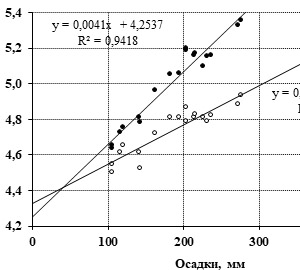
Mathematical methods for describing the processes of evaporation from the soil surface in the conditions of the southern Russia subarid zone are discussed. The analysis of theoretical works in this field and the results of their practical application are made. Mathematical modeling was used to explain the field observations. Mathematical models of evaporation from the soil surface are divided into two types: physico-mathematical models based on the interaction of water with the soil framework and phenomenological models based on balance ratios. The data on evaporation from the surfaces of light soils were analyzed taking into account the diffusion and film transfer of moisture in the pore space. In the analysis of cumulative evaporation from extended territories, a semi-empirical model was used, linking the intensity of evaporation with precipitation and the hydrophysical state of soil moisture aeration. The theory of capillary movement is in good agreement with the data on evaporation from the surface of open sandy soils. A nonlinear relationship between the evaporation rate and the thickness of the underlying surface and humidity has been revealed. The amount of annual precipitation in the south of Russia and cumulative evaporation are connected by power dependence, indicating the capillary-sorption nature of evaporation.

Keywords: evaporation, porosity, aeration zone, pressure gradient, humidity, capillary radius, mathematical modeling, water regime of soils.

Funding. The work was carried out for the state task No. 122020100450-9 “Development of a New Methodology for Optimal Management of Bio Resources in Agrolandscapes of the Arid Zone of the Russian Federation Using System-dynamic Modeling of Soil-hydrological Processes, a Comprehensive Assessment of the Impact of Climate Change and Anthropogenic Loads on Agrobiological Potential and Forest Conditions”.

DOI: 10.24412/1993-3916-2023-2-12-19

EDN: DCKJSF

About the Journal

  • General Information
  • Open Access 
  • Preprint
  • Topics of the journal
  • Editoral Board
  • Editorial Policy
  • Editorial Ethics

Articles Supplying

  • Rules of Manuscripts Supplying
  • Articles Design
  • Article Structure
  • Guidens for Writing an Article
  • Articles Translation

Review of manuscripts

  • Review of manuscripts

Archive

  • 1990s editions
  • 2000s editions
  • 2010s editions
  • 2020s editions
    • Issues for 2020
    • Issues for 2021
    • Issues for 2022
    • Issues for 2023
    • Issues for 2024
    • Issues for 2025
  • Events

_______________________

©2026 - Arid Ecosystems - Weaver Xtreme Theme
↑