↓
 

ISSN 1993-3916

Arid Ecosystems

The “Arid Ecosystems” journal was organized by the decision of General Biology Division of the Russian Academy of Sciences.

  •  Home
  • Preprint
  • Contacts
  • Open Access 
  • Archive
    • Issues 1990s
      • Issues for 1995
      • Issues for 1996
      • Issues for 1997
      • Issues for 1998
      • Issues for 1999
      • Issues for 2000
    • Issues 2000s
      • Issues for 2001
      • Issues for 2002
      • Issues for 2003
      • Issues for 2004
      • Issues for 2005
      • Issues for 2006
      • Issues for 2007
      • Issues for 2008
      • Issues for 2009
      • Issues for 2010
    • Issues 2010s
      • Issues for 2011
      • Issues for 2012
      • Issues for 2013
      • Issues for 2014
      • Issues for 2015
      • Issues for 2016
      • Issues for 2017
      • Issues for 2018
      • Issues for 2019
    • Issues 2020s
      • Issues for 2020
      • Issues for 2021
      • Issues for 2022
      • Issues for 2023
      • Issues for 2024
      • Issues for 2025

Архив метки: Caspian Sea

WIND PERFORMANCE IN THE NORTH-WEST PART OF THE CASPIAN SEA

Arid Ecosystems

Gontovaya I.V., Gavrilova E.V., Ocheretny M.A. WIND PERFORMANCE IN THE NORTH-WEST PART OF THE CASPIAN SEA // Arid Ecosystems. 2025. Vol. 31. № 2 (103). P. 13-19. | PDF

The article considers regional features of the wind regime in the north-western part of the Caspian Sea. The seasonal and annual dynamics of the main characteristics of the wind regime over a multi-year period and current trends in their change are assessed. An analysis of the average wind time series showed that easterly winds dominate the northwestern part of the Caspian Sea, with an average repeatability of 26%. Despite the stability throughout the year, there is some seasonal variability. Other winds include the southeast, west and northwest. Positive seasonal and annual dynamics are observed in southeast winds. Typical features can also be seen for the average wind speed between 1991 and 2020. Regional trend estimates based on time series of average annual air temperatures and average wind speeds show that the average annual air temperature increases with the average annual temperature. The average wind speed increases. The main contribution of the trend to the change of wind speed in the directions belongs to the spring and winter seasons. The northwestern part of the Caspian Sea is dominated by weak winds, most often in gradations of 4-5 m/s. Average wind speeds of 15 m/s are observed in all seasons, in spring and autumn their repeatability is highest. The results are of practical interest as the need for marine climatological data arises from different activities.

Keywords: Caspian Sea, climate, regional changes, wind mode, wind direction and speed, repeatability, practical value, difference of norms, deviation.

DOI: 10.24412/1993-3916-2025-2-13-19

EDN: CVVXMI

APPLICATION OF THE METHODOLOGY OF LAND DEGRADATION NEUTRALITY FOR THE TERRITORY OF CASPIAN SEA REGION

Arid Ecosystems

UDC 502.35; 504.052

Kust G.S., Shklyaeva D.S., Lobkovskiy V.A., Andreeva O.V. APPLICATION OF THE METHODOLOGY OF LAND DEGRADATION NEUTRALITY FOR THE TERRITORY OF CASPIAN SEA REGION // Arid Ecosystems. 2024. Vol. 30. № 2 (99). P. 24-35. | PDF

For more than 20 years studies of the Caspian Region have been carried out under the Framework Convention for the Protection of the Marine Environment of the Caspian Sea (Tehran Convention). Its objective is to protect the Caspian Sea and surrounding terrestrial landscapes from negative impacts. For the first time, the results of a comparative assessment of coastal land dynamics are presented for 5 countries on the basis of land degradation neutrality (LDN): the Republic of Azerbaijan, the Islamic Republic of Iran, the Republic of Kazakhstan, the Russian Federation and Turkmenistan. This approach made it possible to identify the main trends in land dynamics in the region for different observation periods, including those for individual countries and regions. The results are presented in cartographic form. The deterioration of the current situation is currently typical for most of the Caspian Region due to intensified degradation processes. The main “hot spots” of desertification are described. At the same time, the dynamics of land degradation varies in different directions for individual parts of the region and observation periods. A careful selection of different periods of comparison and baselines can help track changes in land dynamics and identify peaks in its improvement and deterioration.

Keywords: land degradation neutrality, Caspian Sea, land degradation, desertification.

Funding. The research was carried out within the framework of the state theme of the IG RAS FMWS-2022-0001 «Spatial and temporal problems of sustainable land use in the context of global climate change» (spatial data processing and formulation of the main provisions and conclusions).

DOI: 10.24412/1993-3916-2024-2-24-35
EDN: YDDPSD

THE GEOMORPHOLOGICAL INTERACTION BETWEEN THE TERRAIN OF THE BAER KNOLLS AND THE VOLGA PALAEODELTAS AT THE END OF THE KHVALYNSK TIME

Arid Ecosystems

UDC 551.79; 551.351.2(262.81); 551.89; 551.468.6

Lobacheva D.M., Badyukova E.N., Makshaev R.R. THE GEOMORPHOLOGICAL INTERACTION BETWEEN THE TERRAIN OF THE BAER KNOLLS AND THE VOLGA PALAEODELTAS AT THE END OF THE KHVALYNSK TIME // Arid Ecosystems. 2023. Vol. 29. № 3 (96). P. 15-23. | PDF

Many geological sections in the ledge of the Lower Volga valley have been actively studied since the end of the 19th century. Results of many years of field work showed that alluvial sediments of the Khvalynsk time (end of the late Pleistocene – early Holocene) are absent in all the studied quaternary sections along the valley. Numerous literary sources, maps and descriptions of wells were used for this research. We conducted geomorphological mapping in ArcGIS using the SRTM DEM and studied many outcrops and wells and carried out field surveys along the Volga valley and in the Baer’s knolls, the giant underwater dunes of the Northern Caspian region. We consider that in the Khvalynsk time the Volga River probably did not run through the site of its current location. In this regard, the question arises of where the Volga channel was located in the North-Western Caspian region. Thus, we propose that the western branch of the Volga ran along the foot of the Eastern Yergeni slopes and eroded the surface of the marine plain, which resulted in the formation of the Sarpinsko-Davanskaya Hollow. Meanwhile, its eastern branches ran into the Khaki Saline, which was one of the estuaries of the Northern Caspian region, where one of the eastern channels of the Paleo Volga probably were flowing into. In the Khvalynsk time, in the lower reaches of the Volga channel there were multiple terminal distributary channels. The large branching delta was much larger (about 200-210 km wide) than the modern delta and somewhat reminiscent of the modern delta of the Lena river in size. Where the modern Volga-Akhtuba floodplain is located now, there was probably a small central branch, in the west there was a Sarpinsky branch, and in the east, an Elton-Khaki branch. They were interconnected by an extensive system of branches, the relief of which is still preserved. At the very end of the Late Khvalynsk time, the Sarpa and Khaki branches began to die off, and most of the water began to run along the central branch, forming the modern Volga-Akhtuba valley.

Keywords: Volga Delta, Caspian Sea, Lower Volga, Baer’s knolls, geomorphology and paleogeography, Late Pleistocene, Khvalynsk time, giant river dunes.

Financing. This work was supported by a grant No. 20-05-00608 “Evolution of the Natural Environment of the Middle Volga Region in the Late Pleistocene: Chronology, Climatorythmics and Correlation with the Events of the Caspian Region”.

DOI: 10.24412/1993-3916-2023-3-15-23

EDN: VTESSF

HYDROECOLOGICAL CONDITION OF THE AGRAKHAN BAY AND POSSIBILITIES FOR ITS IMPROVEMENT

Arid Ecosystems

UDC 556.545, 574.5, 639.2/3

Magritsky D.V., Goncharov A.V., Moreido V.M., Samokhin M.A., Abdusamadov A.S., Kuptsov S.V., Dzhamirzoev G.S., Erina O.N., Sokolov D.I., Arkhipkin V.S., Tereshina M.A., Surkov V.V., Semenova A.A. Hydroecological Condition of the Agrakhan Bay and Possibilities for Its Improvement // Arid Ecosystems. 2022. Vol. 28. № 4 (93). P. 163-178. | PDF

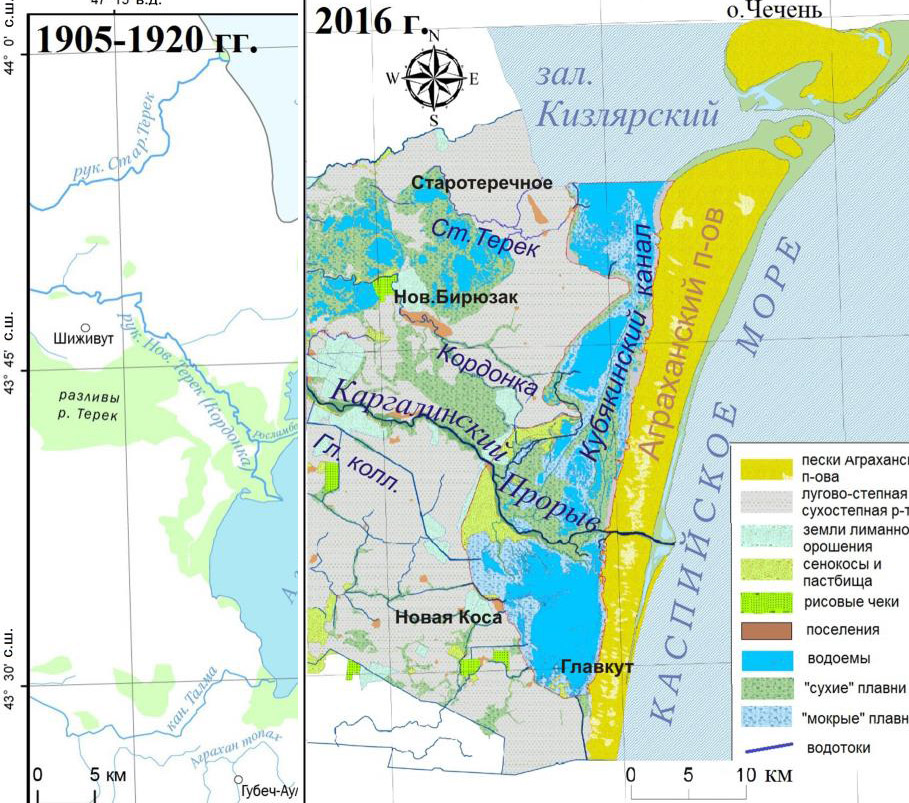
In the XX century, as a result of a combination of natural and anthropogenic factors, there was a significant transformation of the Agrakhan Bay on the eastern coast of the Terek Delta. The comprehensive studies carried out in 2018-2020 made it possible to identify the main causes of this degradation, characterize the current state of the reservoir and scientifically substantiate recommendations for its improvement. It is shown that as a result of shallowing and reduction of the area of the water mirror, the bay has lost its former significance as a spawning and growing reservoir that provides the Western Caspian region with young valuable commercial fish species. Catches by 2018 fell by 10 times compared to the beginning of the XX century; sturgeon, which used to be famous for the Agrakhan Bay, practically disappeared. Especially unfavorable is the state of the northern part of the bay, which has turned into a group of shallow reservoirs, little connected with each other and with the sea. And the situation continues to deteriorate every year.

The study of hydrological-morphological, hydrobiological, fishery, hydrochemical parameters showed that there is hope for improving the condition of wetlands on the site of the former bay. A detailed analysis of the water balance using multivariate limnological calculations showed that there is sufficient water for flooding and partial restoration of water bodies of the hydrographic system of the Agrakhan Bay. Clearing silted and overgrown channels, deepening and collapsing of preserved reservoirs, directing the necessary volumes of river water to the Northern and Southern Agrakhan (in accordance with the calculated supply schedule), will reduce overgrowth and siltation of water bodies, restore water exchange between them, improve water quality, revive the fisheries of the region, improve the habitat conditions of many rare and protected animal species, increase the recreational attractiveness of the region.

Keywords: Agrakhan Bay, Caspian Sea, fisheries, degradation of the bay, water quality, ecological condition, ecological rehabilitation, spawning-growing reservoirs, rare species, hydrological modeling.

Financing. The collection and analysis of materials was carried out under a state contract with the West Caspian STB No. NIR-18-01. The preparation of the article was carried out within the framework of the research of the Department of Land Hydrology of the Geographical Faculty of Lomonosov Moscow State University, carried out within the framework of the state task (CITIS number: 121051400038-1).

DOI: 10.24412/1993-3916-2022-4-163-178

EDN: IBMCGO

POTENTIAL ROLE OF GROUNDWATER IN POLLUTION OF COASTAL WATERS OF THE CASPIAN SEA WITH ORGANIC POLLUTANTS

Arid Ecosystems

Ismayilov N.M., Aliyeva S.R. POTENTIAL ROLE OF GROUNDWATER IN POLLUTION OF COASTAL WATERS OF THE CASPIAN SEA WITH ORGANIC POLLUTANTS // Arid ecosystems. 2019. V. 25. № 3 (80). P. 70-78. | PDF For the first time we predict the … Читать далее →

INTEGRATED DIAGNOSTICS OF SEA WATER QUALITY WITH THE USAGE OF PHYTO AND ZOOPLANKTON

Arid Ecosystems

Rabazanov N.I., Sokolsky A.F., Evseeva S.S., Rabazanov R.N. INTEGRATED DIAGNOSTICS OF SEA WATER QUALITY WITH THE USAGE OF PHYTO AND ZOOPLANKTON // Arid ecosystems. 2019. V. 25. № 3 (80). P. 79-84. | PDF In this article we give the … Читать далее →

About the Journal

  • General Information
  • Open Access 
  • Preprint
  • Topics of the journal
  • Editoral Board
  • Editorial Policy
  • Editorial Ethics

Articles Supplying

  • Rules of Manuscripts Supplying
  • Articles Design
  • Article Structure
  • Guidens for Writing an Article
  • Articles Translation

Review of manuscripts

  • Review of manuscripts

Archive

  • 1990s editions
  • 2000s editions
  • 2010s editions
  • 2020s editions
    • Issues for 2020
    • Issues for 2021
    • Issues for 2022
    • Issues for 2023
    • Issues for 2024
    • Issues for 2025
  • Events

_______________________

©2026 - Arid Ecosystems - Weaver Xtreme Theme
↑